Our Short List of 3

- Best for: Boaters running a heavy four-stroke kicker up to 35 HP who want five height positions and a safety cable in the box.
- Rated for auxiliary motors up to 35 HP
- 10-inch vertical travel with five running positions
- Hard-coat anodized aluminum construction
- Stainless steel torsion springs counterbalance the motor
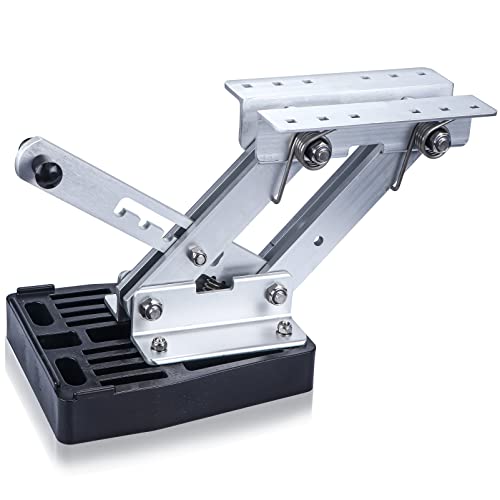
- Best for: Small-boat owners hanging a light two-stroke kicker who want five height positions at a modest weight.
- Rated for 2-stroke motors from 7.5 to 20 HP
- Five-position locking height adjustment, 195 to 320 millimeters
- Stainless steel counter-balance springs
- Heavy-duty aluminum frame

- Best for: Boaters who want a fixed 20-inch setback for a single outboard and clean water at the propeller.
- 20-inch setback from the transom
- Heavy-duty aluminum construction
- White powder-coated finish
- 17.5 inches wide by 19.5 inches high
All 5 Picks at a Glance
| Product | Specs | Action |
|---|---|---|
| Panther Marine 55-0410 Auxiliary Outboard 4-Stroke Motor Bracket |
| Check price on Amazon |
| Marinebaby Boat Outboard Motor Bracket, Aluminum Boat Engine Support 20 HP |
| Check price on Amazon |
| KUAFU 20-Inch Outboard Single Engine Bracket |
| Check price on Amazon |
 YaeMarine 2 Stroke Outboard Motor Bracket Kicker, up to 25 HP |
| Check price on Amazon |
 Marinetech Panther 550021 Outboard Aluminum Motor Bracket |
| Check price on Amazon |
Key takeaways
- Find the best transom bracket for outboard motors: 5 adjustable kicker brackets rated 15 to 35 HP, compared by travel, setback and mounting.
A transom bracket is the piece of hardware that lets a second outboard live on the back of your boat, and the wrong one means a season of trouble. The real decision is not which bracket looks strongest in a photo, but which one matches your motor: its horsepower rating, its weight, and the way its torque twists against the transom when you open the throttle. Get any of those wrong and the bracket flexes, the motor sits too deep or too shallow, and the cavitation plate never lines up with the hull.
This article is for anglers who troll with a kicker, sailors who need a reliable auxiliary on the stern, and small-boat owners who want a backup motor that actually deploys when the main engine quits. Every bracket below is an adjustable auxiliary outboard bracket that bolts to the transom, chosen from names and specs on Amazon product pages, with horsepower ratings and setback stated openly, so you can match one to your motor before drilling.
Quick Picks
As an Amazon Associate we earn from qualifying purchases
| Product | Best for | Key spec from title |
|---|---|---|
| Panther Marine 55-0410 | Heavy 4-stroke kickers up to 35 HP | 10-inch vertical travel |
| Marinebaby Outboard Motor Bracket 20 HP | Light 2-stroke motors on small boats | 5-position height adjustment |
| KUAFU 20-Inch Outboard Single Engine Bracket | Fixed setback for a single outboard | 20-inch setback |
| YaeMarine 2 Stroke Outboard Motor Bracket | Budget 2-stroke kickers up to 25 HP | 110-pound weight capacity |
| Marinetech Panther 550021 | Simple fixed mounting up to 20 HP | Aluminum motor bracket |
How to Choose
Match the HP rating and the motor weight
A bracket has two limits and both matter: the horsepower rating and the motor weight. A 20 HP four-stroke weighs far more than a 20 HP two-stroke, and its torque twists harder against the transom, so a bracket rated for a 20 HP two-stroke can still be wrong for a 20 HP four-stroke. Check the maker rating for your exact motor type, then weigh your motor with fuel and oil. If the motor is close to the weight limit, step up to the next bracket. Panther builds its 55-0410 for four-strokes up to 35 HP for exactly this reason, while the Marinebaby and YaeMarine brackets are rated for two-strokes only.
Get the vertical travel and shaft depth right
Vertical travel is how far the bracket lifts and lowers the motor, and it decides whether the propeller stays submerged when the boat is loaded and clears the water when raised. Measure from the inside top of your motor clamp to the cavitation plate, subtract 2 inches, then add the bracket travel. That sum is the adjusted shaft length your setup needs. Ten inches of travel covers most long and short shaft motors, but a short shaft motor on a tall transom can still run dry. Five locking positions, like those on the Panther and Marinebaby brackets, let you fine-tune depth for load and sea conditions.
Understand setback before you drill
Setback is how far the bracket pushes the motor behind the transom, and it changes steering clearance, weight distribution, and how the boat handles at speed. A fixed setback bracket like the KUAFU holds the motor 20 inches aft, which gives the propeller clean water and room for a swim platform, but it also moves weight rearward and can change how the bow rides. An adjustable bracket changes its setback as it moves: the Panther 55-0407AL, for example, sits 8.75 inches back at the top position and 14 inches back at the bottom. Before drilling, check that the motor swings clear of the swim platform, the rudder, and the main engine at full lock.
Mounting hardware, materials, and the safety cable
A bracket is only as strong as its fasteners and the transom behind it. Most brackets in this article ship without mounting hardware, so budget for stainless steel bolts, washers, and a backing plate on the inside of the transom, bedded in marine sealant. Anodized aluminum resists saltwater corrosion and keeps the bracket light, while stainless steel brackets are heavier but tougher in rough service. Always fit the safety cable that comes with Panther brackets: it is the only thing keeping your motor from sinking if the bracket ever lets go. Check the cable, the springs, and the locking knobs at the start of every season.
The 5 Best Options
Panther Marine 55-0410 Auxiliary Outboard 4-Stroke Motor Bracket
- Best for: Boaters running a heavy four-stroke kicker up to 35 HP who want five height positions and a safety cable in the box.
- Rated for auxiliary motors up to 35 HP
- 10-inch vertical travel with five running positions
- Hard-coat anodized aluminum construction
- Stainless steel torsion springs counterbalance the motor
Boaters running a heavy four-stroke kicker up to 35 HP who want five height positions and a safety cable in the box.
The setback figure is not published on the listing, so check the Panther install sheet and measure steering clearance before drilling.
The 55-0410 is the bracket to buy when the kicker is a heavy modern four-stroke and the bracket has to live with its torque every time you troll. Panther rates it for auxiliary motors up to 35 HP, gives it 10 inches of vertical travel across five running positions, and builds it from hard-coat anodized aluminum with stainless steel torsion springs that counterbalance the motor, so height changes take a turn of a knob. The 2-inch thick mounting board is extra wide, the bracket meets ABYC standards, and the included 55-0415 safety cable is part of the package rather than an accessory you have to remember.
Watch out for: The setback figure is not published on the listing, so check the Panther install sheet and measure steering clearance before drilling.
Marinebaby Boat Outboard Motor Bracket, Aluminum Boat Engine Support 20 HP
- Best for: Small-boat owners hanging a light two-stroke kicker who want five height positions at a modest weight.
- Rated for 2-stroke motors from 7.5 to 20 HP
- Five-position locking height adjustment, 195 to 320 millimeters
- Stainless steel counter-balance springs
- Heavy-duty aluminum frame
Small-boat owners hanging a light two-stroke kicker who want five height positions at a modest weight.
Mounting hardware is not included, so buy 8-millimeter stainless screws separately, and do not hang a heavy four-stroke on a bracket rated for two-strokes.
The Marinebaby bracket is a straightforward aluminum bracket for small boats carrying a light two-stroke, and it covers the most common kicker sizes without the weight or bulk of a heavy-duty unit. It is rated for two-stroke motors from 7.5 to 20 HP, with a five-position locking height adjustment that runs from 195 to 320 millimeters so you can set the propeller depth for your transom and load. Stainless steel springs counterbalance the motor, the frame is heavy-duty aluminum, and the mounting board is solid polypropylene that will not rot or soak up water the way plywood does.
Watch out for: Mounting hardware is not included, so buy 8-millimeter stainless screws separately, and do not hang a heavy four-stroke on a bracket rated for two-strokes.
KUAFU 20-Inch Outboard Single Engine Bracket
- Best for: Boaters who want a fixed 20-inch setback for a single outboard and clean water at the propeller.
- 20-inch setback from the transom
- Heavy-duty aluminum construction
- White powder-coated finish
- 17.5 inches wide by 19.5 inches high
Boaters who want a fixed 20-inch setback for a single outboard and clean water at the propeller.
No instructions are included, so a first-time installer should budget for professional fitting, and the fixed setback moves weight aft, which changes how the bow rides.
The KUAFU is a fixed setback bracket, which makes it a different tool from the adjustable brackets above: instead of lifting and lowering a kicker, it holds a single outboard 20 inches behind the transom on a rigid mount. That fixed setback gives the propeller clean, undisturbed water and keeps the motor clear of a swim platform or a crowded stern, which is why setback brackets are popular on flats boats and center consoles. The bracket is heavy-duty aluminum with a white powder-coated finish, measures 17.5 inches wide by 19.5 inches high, and fits Mercury, Yamaha, Evinrude, Honda, and Johnson motors with the included installation accessories.
Watch out for: No instructions are included, so a first-time installer should budget for professional fitting, and the fixed setback moves weight aft, which changes how the bow rides.
YaeMarine 2 Stroke Outboard Motor Bracket Kicker, up to 25 HP
- Best for: Budget-conscious owners of small boats who need a stainless bracket for a two-stroke kicker up to 25 HP.
- Rated for 2-stroke motors up to 25 HP
- Weight capacity up to 110 pounds
- All stainless stamped construction
- Five vertical running position lock bars
Budget-conscious owners of small boats who need a stainless bracket for a two-stroke kicker up to 25 HP.
The listing warns about sharp edges on the stamped steel, so wear gloves during installation, and it is rated for two-strokes only, not four-strokes.
The YaeMarine bracket is the budget pick for a two-stroke kicker up to 25 HP, built entirely from stamped stainless steel rather than aluminum. It carries motors up to 110 pounds, adjusts through five vertical running positions with lock bars, and uses stainless nylock nuts and locking safety knobs to hold the motor where you set it. The stamped stainless construction resists saltwater corrosion, and the bracket mounts to nearly any flat transom, which makes it a practical choice for jon boats, small skiffs, and tenders that need a trolling motor without a big hardware bill.
Watch out for: The listing warns about sharp edges on the stamped steel, so wear gloves during installation, and it is rated for two-strokes only, not four-strokes.
Marinetech Panther 550021 Outboard Aluminum Motor Bracket
- Best for: Owners who want a simple fixed aluminum bracket for a small auxiliary up to 20 HP with nothing to adjust.
- Rated for outboards up to 20 HP
- Aluminum motor bracket
- Manufacturer part number 550021
- Brand Marinetech, manufacturer Panther
Owners who want a simple fixed aluminum bracket for a small auxiliary up to 20 HP with nothing to adjust.
One roundup detail table lists the material as plastic while the listing title says aluminum, so confirm the material and the live offer in the cart before ordering.
The Panther 550021 is the simplest bracket in this article: a fixed aluminum motor bracket rated for outboards up to 20 HP, with no springs, no travel, and no adjustments to maintain. That simplicity suits a small auxiliary that stays mounted at one height, or a sailboat kicker that only needs to be in the water or out of it. Panther backs it with a one-year manufacturer warranty, and the bracket is a long-standing part in the Panther catalog, which means the mounting pattern and hardware are well documented by dealers and riggers.
Watch out for: One roundup detail table lists the material as plastic while the listing title says aluminum, so confirm the material and the live offer in the cart before ordering.
Which One Fits Your Situation
You troll with a heavy four-stroke kicker
Pick the Panther 55-0410. It is the only bracket here rated for four-stroke torque up to 35 HP, with extra-heavy springs and a safety cable included. The five height positions let you keep the propeller buried when the boat is loaded with gear and anglers, and the anodized aluminum shrugs off saltwater seasons.
You have a small sailboat and a light two-stroke
Pick the Marinebaby bracket. It handles two-stroke motors from 7.5 to 20 HP, the five-position adjustment covers 195 to 320 millimeters of height, and the polypropylene board will not rot. Buy 8-millimeter stainless screws with it, since mounting hardware is not included.
You want setback for a single outboard
Pick the KUAFU 20-inch bracket. The fixed 20-inch setback gives the propeller clean water and clears a swim platform, and the universal fit covers the major motor brands. Get a professional to fit it, since no instructions are included and the setback changes how the boat trims.
You need a cheap stainless bracket for a jon boat
Pick the YaeMarine bracket. It carries a two-stroke up to 25 HP and 110 pounds, the stamped stainless steel resists corrosion, and the five lock bars hold the height you set. Wear gloves for the sharp edges, and do not hang a four-stroke on it.
Common Mistakes
- Buying a bracket by horsepower alone and ignoring the motor weight, which is what actually breaks brackets.
- Hanging a heavy four-stroke on a bracket rated for two-strokes, which are lighter and produce less torque at the same horsepower.
- Setting the propeller depth by eye instead of measuring from the clamp to the cavitation plate, subtracting 2 inches, and adding the bracket travel.
- Drilling the transom without a backing plate and marine sealant, which lets the bolts work loose and water into the core.
- Skipping the safety cable, so a bracket failure becomes a lost motor instead of a tow home.
Frequently Asked Questions
What size transom bracket do I need for my outboard?
Match the bracket to the horsepower rating and the motor weight, including fuel and oil, and check it covers your two-stroke or four-stroke. Then measure from the inside top of the motor clamp to the cavitation plate, subtract 2 inches, and add the bracket travel for the adjusted shaft length. If the motor nears the weight limit, step up rather than trusting the horsepower number alone.
Can I use a transom bracket with a four-stroke motor?
Only if the bracket is rated for four-stroke use. Four-stroke motors are heavier and produce more torque than two-strokes of the same horsepower, so a bracket rated for a 20 HP two-stroke can fail under a 20 HP four-stroke. The Panther 55-0410 in this article is built for four-strokes up to 35 HP, while the Marinebaby and YaeMarine brackets are rated for two-strokes only.
What is setback, and why does it matter?
Setback is the distance the bracket holds the motor behind the transom. More setback gives the propeller cleaner water and clears swim platforms and rudders, but it also moves weight rearward and changes how the boat trims. Fixed brackets like the KUAFU hold a set 20 inches, while adjustable brackets change setback as they move, so check steering clearance at full lock before drilling.
Do I need a safety cable with a transom bracket?
Yes. The safety cable ties the motor to the boat so it cannot sink if the bracket fails, the springs break, or a bolt works loose. Panther includes its 55-0415 safety cable with the 55-0410, and the install instructions for the Panther brackets treat it as mandatory. Inspect the cable, the springs, and the locking knobs at the start of every season.