Our Short List of 3

All 3 Picks at a Glance
| Product | Specs | Action |
|---|---|---|
| 1. Odyssey ODX-AGM31 Extreme Series — The Pick That Clears Every 5520 Spec | Check price on Amazon | |
 3. Mighty Max MM-G31 — A Value Group 31 for Early-Spec Tractors | Check price on Amazon | |
 4. Interstate 31M-AGM-A — Dual-Purpose Reserve, With Two Caveats | Check price on Amazon |
Key takeaways
- Find the best battery for a JD 5520 tractor: the correct Group 31 size, the CCA and reserve capacity John Deere specifies, and AGM picks that meet or beat it.
As an Amazon Associate we earn from qualifying purchases.
A John Deere 5520 that cranks slowly on a cold morning is rarely suffering from a mysterious electrical fault. It is usually suffering from a battery that no longer meets the specification printed in the operator documentation — or from a replacement battery that never met it in the first place. The 5520 is a utility tractor with a four-cylinder diesel, and diesel starting is unforgiving: glow plugs draw current before the starter even turns, and the starter itself has to spin a high-compression engine against thick, cold oil. A battery that is merely “close” on paper will expose itself on the first frosty start of the season.
This guide starts with the specification John Deere actually publishes for this tractor family, then walks through the replacement batteries that match it. Every pick below is a 12-volt battery in the correct case size for the tractor, and each one is labelled honestly where its cranking rating sits against the two different factory ratings you will find for the 5520. Read the fitment section before you order anything, because the 5520 was built across several years and the documented battery requirement changed during the run.
Affiliate Disclosure: This article contains affiliate links. If you buy through a link on this page, we may earn a commission at no additional cost to you. Product specifications are taken from the manufacturers’ and sellers’ product pages, and we have not personally tested these batteries in a 5520.
The JD 5520 Battery Specification, From John Deere’s Own Documentation
Two numbers matter here, and they do not agree with each other, which is exactly why 5520 owners end up confused.
John Deere’s operator documentation for this tractor family describes a dual-battery arrangement: two 12-volt batteries with negative ground, connected in series, and it states the replacement requirement plainly — Battery Group 31, 950 cold cranking amps, and 190 minutes of reserve capacity at a 25-amp draw. Group 31 is the physical case size. The 950 CCA figure is the cranking power each battery must deliver at 0 degrees Fahrenheit, and the 190-minute reserve capacity describes how long the battery can sustain a moderate load before its voltage falls too low.
Separately, specification summaries for the 5520 list a single 12-volt battery with a cold cranking rating of 700 amps on earlier production and 950 amps on later production. In other words, early tractors left the factory with a lighter cranking requirement than later ones, and Deere’s own service documentation for the family sets the bar at the higher figure.
The practical takeaway is simple and it protects you either way:
- Case size: Group 31. This is non-negotiable if you want the battery to sit correctly in the tray and accept the hold-down and cables without modification.
- Voltage: 12 volts per battery, negative ground.
- Cranking target: Match or exceed the rating on the label of the battery currently in your tractor. If your tractor’s documentation or original battery says 950 CCA, treat 950 as the floor. If your early tractor is documented at 700 CCA, a battery rated above that figure is acceptable, though headroom is still valuable.
- Reserve capacity: Aim for the 190-minute neighbourhood or better on tractors that run lights, a cab blower, or implements with the engine at low speed for long stretches.
One more point before the picks: the factory John Deere StrongBox battery for this application is sold through Deere dealers rather than through general online marketplaces. If you want the exact dealer part, a Deere parts counter is the correct route. The batteries below are aftermarket Group 31 equivalents chosen because they are the same type of battery — 12-volt starting and dual-purpose batteries in the Group 31 case — and because their published ratings can be compared directly against the Deere specification above.
Quick Comparison
| Battery | Group | CCA | Capacity | Reserve Capacity | Terminals |
|---|---|---|---|---|---|
| Odyssey ODX-AGM31 Extreme Series | 31 | 1,150 | 98 Ah | About 205 minutes | Threaded stud |
| Odyssey ODX-AGM31M Extreme Series | 31M | 1,150 | 103 Ah | 220 minutes | SAE posts plus studs |
| Mighty Max MM-G31 | 31 | 900 | 100 Ah | 140 minutes | Bolt terminal |
| Interstate 31M-AGM-A (8-31MAGMDC) | 31M | 825 | 100 Ah | 200 minutes | Marine terminal |
1. Odyssey ODX-AGM31 Extreme Series — The Pick That Clears Every 5520 Spec
The Odyssey Extreme Series ODX-AGM31 is the easiest recommendation in this guide because it does not ask you to compromise on any line of the Deere specification. It is a 12-volt AGM battery in the Group 31 case, rated at 1,150 cold cranking amps — comfortably above the 950 CCA figure in John Deere’s documentation and far above the 700 CCA rating of the earliest tractors. Its listed capacity is 98 amp-hours, and published reserve capacity figures for this model sit around 205 minutes, which clears the 190-minute Deere benchmark as well.
The construction is thin plate pure lead AGM. In plain terms, the plates are made from pure lead rather than a lead alloy, they are packed tightly into the case, and the electrolyte is absorbed into glass mat separators instead of sloshing around as free liquid. For a tractor, the two benefits that matter are vibration resistance and starting consistency. A utility tractor lives on rough ground, idles with a pronounced diesel shake, and spends its life being bounced across headlands. AGM construction tolerates that environment better than a conventional flooded battery, and the sealed case means there is no electrolyte to check and no acid to spill if the tractor works on slopes.
The trade-offs are weight, terminal style, and the discipline of buying the right variant. This battery weighs roughly as much as you would expect from a large pure-lead AGM — plan on a two-handed lift and a helper if the battery compartment on your tractor is awkward to reach. The ODX-AGM31 uses threaded stud terminals rather than the tapered SAE posts found on many farm batteries, so check your cable ends before ordering. If your 5520’s cables terminate in ring lugs, studs are arguably the better connection. If they are post clamps, the marine variant reviewed next is the version to look at, or you will need adapters.
For a later-production 5520 documented at 950 CCA, this is the battery on this page that meets the factory figure with genuine headroom to spare, which matters more with every year of service, because a battery’s delivered cranking power declines as it ages. Starting with margin is how you avoid the mid-winter no-start.
2. Odyssey ODX-AGM31M Extreme Series — Same Cranking Power, Friendlier Terminals
ASIN: B000TCRERQ
The ODX-AGM31M is the marine-terminal sibling of the battery above, built on the same Extreme Series thin plate pure lead AGM platform. Its published ratings are 1,150 cold cranking amps, a 20-hour capacity of 103 amp-hours, and a reserve capacity of 220 minutes. Against the John Deere figures — Group 31 case, 950 CCA, 190 minutes of reserve — it clears every line, and its reserve capacity is the strongest in this guide, which suits tractors that run lighting and cab electrics hard during early-morning and late-evening work.
The reason to choose the M variant over the standard ODX-AGM31 comes down to what is on top of the case. The marine version combines SAE automotive posts with threaded stud connections. If your tractor’s battery cables end in conventional post clamps, they drop straight onto the posts, and the studs remain available for accessory leads such as a trickle charger harness, a work-light relay feed, or a cab accessory circuit. That flexibility is genuinely useful on a working tractor that accumulates electrical additions over the years.
Be aware of two things. First, the M case is a Group 31M, which shares the Group 31 footprint, but you should still confirm the height and hold-down arrangement against your tray, because terminal hardware on marine variants can sit differently. Second, this is a dual-purpose design — it is built both to crank an engine and to sustain deeper discharge than a pure starting battery. That is a benefit for a tractor that occasionally sits with lights on or powers accessories, not a drawback, but it does mean you are paying for capability a lightly used tractor may never call on.
If your 5520 is a later, 950 CCA tractor and your cables are post-clamp type, this is arguably the most straightforward like-for-like upgrade in the guide: factory-beating cranking power, the highest reserve capacity here, and terminals that match what most farm cable sets already have.
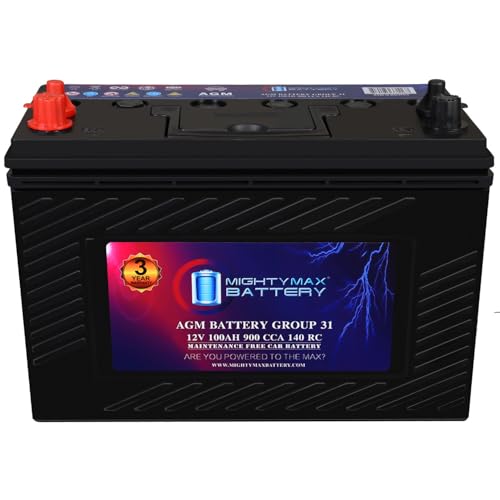
3. Mighty Max MM-G31 — A Value Group 31 for Early-Spec Tractors
The Mighty Max MM-G31 is a 12-volt, 100 amp-hour AGM battery in the Group 31 case, listed at 900 cold cranking amps and 140 minutes of reserve capacity. It is a sealed, spill-proof AGM design, and the listing describes it as a start-and-stop style starting battery with bolt terminals.
This battery needs an honest label, and here it is: 900 CCA clears the 700 CCA rating documented for early 5520 production with room to spare, but it falls short of the 950 CCA figure in Deere’s later documentation, and its 140-minute reserve capacity is well below the 190-minute benchmark. That does not make it a bad battery. It makes it a battery for a specific tractor — an early-spec machine, in a mild climate, that starts daily and does not sit for long periods running electrics on battery power alone. For that tractor, it delivers genuine Group 31 fitment and AGM convenience at the accessible end of this guide.
It is the wrong choice for a later 950 CCA tractor, and it is a marginal choice for any 5520 that lives outdoors in a cold region, because cold is precisely where the gap between 900 and 950 rated amps — plus the further drop as the battery ages — turns into a slow crank. Mighty Max also publishes dimensions of approximately 12.88 by 6.75 by 9.5 inches and a weight of about 57.6 pounds, noticeably lighter than the Odyssey units above, which reflects its different plate construction.
Our advice is mechanical: read the CCA figure on the battery you are taking out. If it says 700, this battery is a legitimate, economical replacement. If it says 950, skip to the first two picks and do not talk yourself into the saving.
4. Interstate 31M-AGM-A — Dual-Purpose Reserve, With Two Caveats
Interstate’s 31M-AGM-A, sold under part number 8-31MAGMDC, is a 12-volt pure lead AGM battery in the Group 31M case. The published specification is 100 amp-hours, 825 cold cranking amps, 1,031 marine cranking amps, and a reserve capacity of 200 minutes, with a two-year free replacement warranty according to the product information. It is sold by Interstate Batteries itself through its marketplace storefront, which counts for something with a product category where warranty handling matters.
The reserve capacity is the headline strength: 200 minutes exceeds the 190-minute figure in Deere’s documentation, and the pure lead AGM construction is designed for both starting duty and sustained accessory loads. On an early-spec 5520 documented at 700 CCA, the 825 CCA rating is adequate with margin.
The two caveats are real, though. First, 825 CCA does not meet the 950 CCA requirement documented for later tractors, so this is not a battery for those machines, full stop. Second, it is a marine and RV battery by designation, fitted with marine terminals, and its listed vehicle applications lean toward trailers, boats, and RVs rather than agricultural equipment. The Group 31M case fits the same footprint, and dual-purpose AGM batteries of this type are physically the same class of product as the others in this guide, but you must confirm your cable ends suit the marine terminals, and you should go in understanding that you are fitting a dual-purpose battery rather than a dedicated agricultural starting battery.
Within those limits, it earns its place for one buyer: the owner of an early-spec 5520 who runs a lot of electrical load — extra lighting, a sprayer controller, a cab fan — and values reserve capacity and a manufacturer-run storefront over maximum cranking amps.
How to Confirm Fitment on Your 5520 Before Ordering
Specifications on a page are no substitute for five minutes with the tractor itself. Work through this checklist before any Group 31 battery goes in your basket.
Read the old battery first. The label on the battery you remove tells you the group size, the CCA rating Deere’s specification was matched to, and the terminal layout. Photograph the label and the cable arrangement before disconnecting anything. If the old battery is not a Group 31, find out why — a previous owner may have fitted whatever was on the shelf, and copying their mistake perpetuates it.
Count the batteries. Deere’s documentation for this family describes two 12-volt batteries connected in series, while specification summaries for the 5520 describe a single battery. Tractors in the field reflect both arrangements depending on configuration and market. If your tractor has two batteries, replace them as a matched pair of the same model and similar age. Mixing an old battery with a new one in a series pair makes the weaker unit drag the pair down and shortens the new battery’s life.
Measure the tray and check the terminals. Group 31 batteries are roughly 13 inches long, 6.8 inches wide, and 9.4 to 9.7 inches tall including terminals, but hold-down style and terminal position vary between the stud, post, and marine variants in this guide. Confirm your cables reach the terminals of the specific variant you are buying without strain, and that the positive cable cannot contact the hold-down or bodywork.
Match polarity. Confirm which side the positive terminal sits on in your tractor and compare it with the battery diagram on the product page. A reversed layout can leave cables too short or, worse, tempt a crossed connection.
Fitting and Care Notes for Tractor Batteries
Disconnect the negative cable first and reconnect it last. On a dual-battery tractor, follow the series wiring exactly as photographed — a series pair doubles the voltage, and a wiring error at reconnection is an expensive mistake. Clean the cable ends and terminals to bright metal, tighten them firmly, and protect the finished connections against corrosion, because a high-resistance connection imitates a weak battery perfectly: slow cranking, hot terminals, and a starter that tests fine on the bench.
Charging deserves a word. AGM batteries want a charger with an AGM profile and a regulated voltage; an old unregulated charger left connected indefinitely will shorten an AGM battery’s life. A tractor that works seasonally benefits from a maintainer during storage, and a battery that has been deeply discharged should be recharged promptly rather than left flat, since lead-acid batteries deteriorate quickly when stored discharged.
Finally, load-test before you condemn. If a correctly specified, fully charged battery still cranks the 5520 slowly, the fault may be in the starter motor, the ground strap between engine and frame, or the cable run itself. Replacing a good battery will not cure a corroded ground, and the checks cost nothing but time.
Verdict
For most JD 5520 owners, the decision resolves into one question: what does your tractor’s documentation — or the label on its current battery — say about cranking amps? If the answer is 950, buy one of the two Odyssey Extreme Series batteries. The ODX-AGM31 suits ring-lug cables, the ODX-AGM31M suits post-clamp cables and adds the strongest reserve capacity in this guide, and both clear the full Deere specification with headroom that will still be there in five winters’ time.
If your tractor is an early machine documented at 700 CCA, the field opens up. The Mighty Max MM-G31 is the economical Group 31 route, and the Interstate 31M-AGM-A trades some cranking rating for reserve capacity and manufacturer-backed warranty handling. Neither should be fitted to a 950 CCA tractor, and this guide has labelled them accordingly rather than pretending otherwise.
Whichever you choose, replace like with like on group size, replace a series pair together, and verify the listing’s current specification and availability before ordering — battery listings change, and the label on your tractor is the final authority.