Our Short List of 3
All 4 Picks at a Glance
| Product | Specs | Action |
|---|---|---|
 1. Yuasa YTX9-BS (YUAM329BS) — The Original-Equipment Choice | Check price on Amazon | |
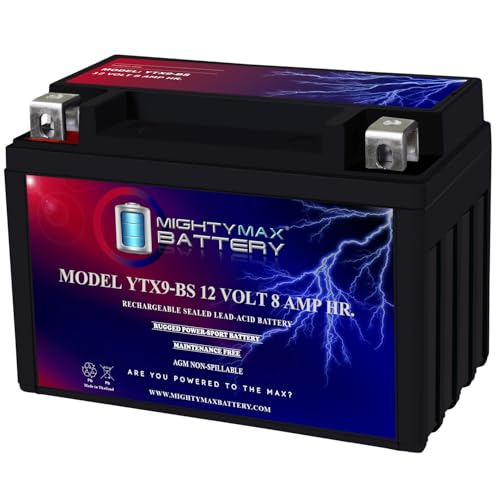 2. Mighty Max Battery YTX9-BS — Sealed AGM With Matching Ratings | Check price on Amazon | |
 3. WEIZE YTX9-BS — A Maintenance-Free Alternative in the Same Format | Check price on Amazon | |
 4. UPLUS EB9-4 YTX9-BS — Another Sealed AGM in the Exact Size | Check price on Amazon |
Key takeaways
- Find the best battery for Rouser 180, the Latin American name for the Bajaj Pulsar 180, in the correct 12V 9Ah YTX9-BS size with fitment, polarity and charging checks.
As an Amazon Associate we earn from qualifying purchases.
Affiliate Disclosure: This article contains affiliate links. If you buy through a link on this page, we may earn a commission at no extra cost to you. Product specifications are taken from manufacturer and retailer listings, and we have not personally tested these batteries.
If you are searching for the best battery for Rouser 180, the first thing to know is what the name means. Rouser is the name Bajaj uses for its Pulsar range in several Latin American markets, and the Rouser 180 is the Bajaj Pulsar 180 sold under that regional name. It is a motorcycle, not a car, and it does not take a car battery. That single fact rules out most of the wrong results a search for this keyword can produce, and it is stated plainly here so the rest of this guide can be read with the right vehicle in mind.
Once the vehicle is clear, the battery specification is clear too. Bajaj’s own documentation for the Pulsar 180 DTS-i lists the battery as 12 volts, 9 amp-hours, maintenance-free. The service literature gives the same figure: the Pulsar 180 uses a 12-volt, 9 amp-hour battery, while its smaller Pulsar 150 sibling uses a smaller 7 amp-hour unit. The industry-standard case that matches this specification is the YTX9-BS format — a sealed powersports battery measuring roughly 150 millimetres long, 87 millimetres wide, and 105 millimetres high. Every pick in this guide is a YTX9-BS motorcycle battery in that size, from a listing on Amazon US, with its published ratings stated so you can compare them honestly.
The Specification You Are Shopping For
Before looking at brands, fix the requirements in your mind. Voltage must be 12 volts; there is no alternative. Capacity should be at or very near the original 9 amp-hour rating. In practice, most YTX9-BS batteries are rated at 8 amp-hours at the 10-hour rate or around 8.4 amp-hours at the 20-hour rate, even from the original-equipment maker, because rating conventions differ. That is not a downgrade to worry about: a genuine YTX9-BS from a reputable maker is the correct replacement for the 12-volt, 9 amp-hour maintenance-free battery Bajaj specifies, and the case, terminals, and cranking performance are what define the fit.
Cold cranking performance for this size is typically around 135 cold cranking amps in the original-equipment specification. Dimensions should be close to 150 by 87 by 105 millimetres, the battery sits inside the left-hand side cover on the Pulsar 180 according to Bajaj’s owner documentation, and the terminal layout of a true YTX9-BS has the positive terminal on the left when viewed from the front of the battery. Any battery that differs on case size or polarity — including the similarly named YTX9B or 9-B formats, which use a different case — should be treated as a different battery, not as an equivalent.
Our Picks at a Glance
| Pick | Format | Capacity as listed | Cranking rating as listed | Best for |
|---|---|---|---|---|
| Yuasa YTX9-BS (YUAM329BS) | YTX9-BS, bottle-supplied AGM | 8 Ah at the 10-hour rate | 135 CCA | Riders who want the original-equipment maker’s battery |
| Mighty Max Battery YTX9-BS | YTX9-BS, sealed AGM | 8 Ah | 135 CCA | A ready-to-use sealed replacement with matching ratings |
| WEIZE YTX9-BS | YTX9-BS, maintenance-free lead-acid | 8 Ah class | See listing for current rating | An alternative YTX9-BS listing from an established battery brand |
| UPLUS EB9-4 YTX9-BS | YTX9-BS, sealed AGM | 8 Ah | See listing for current rating | A further sealed AGM option in the exact format |
1. Yuasa YTX9-BS (YUAM329BS) — The Original-Equipment Choice
Yuasa is the maker that created the YTX designation, and its YTX9-BS is the reference battery for this size. The Yuasa specification lists 12 volts, an 8 amp-hour capacity at the 10-hour rate and 8.4 amp-hours at the 20-hour rate, 135 cold cranking amps, and dimensions of about 150 by 87 by 105 millimetres, with a filled weight of about 6.6 pounds. The part number for the battery is YUAM329BS. This is an absorbed glass mat, maintenance-free design, and Yuasa’s data confirms the positive terminal on the left.
One practical point defines this pick: it is a bottle-supplied battery, which is what the BS suffix means. It ships dry with a pre-measured acid pack, and you fill it, seal it, and charge it before first use, following the maker’s instructions exactly, with gloves and eye protection and away from children and ignition sources. Done correctly, that process is also an advantage — a battery that is only activated when you fill it has not been sitting self-discharging on a shelf since manufacture, so it starts its service life genuinely fresh. Done carelessly, acid handling is a real hazard, so if you are not comfortable with the filling process, choose one of the sealed, factory-ready picks below instead and do not improvise.
Choose the Yuasa if you want the original specification from the company that defined it and you are happy to carry out the activation and first charge properly. It is the closest thing to a factory answer this keyword has.
2. Mighty Max Battery YTX9-BS — Sealed AGM With Matching Ratings
The Mighty Max YTX9-BS listing states 12 volts, 8 amp-hours, and 135 cold cranking amps, in a rechargeable, maintenance-free sealed lead-acid AGM design. The model reference on the listing is YTX9-BS, with a manufacturer part number of YTX9-BS98. Its published dimensions in retailer data are about 5.90 by 3.38 by 4.25 inches, which correspond closely to the standard YTX9-BS case, allowing for rounding between sources.
For a Rouser 180 or Pulsar 180 owner, the appeal is simplicity. A sealed AGM battery arrives ready to fit without an acid-filling step, it tolerates the vibration a single-cylinder motorcycle produces, and its headline ratings match the original-equipment figures for this format rather than inflating them. That last point is worth valuing: in this category, a listing that claims dramatically higher cranking numbers for the same small case deserves more scepticism than a listing that matches the established specification.
As with any battery bought online, check the delivered unit against the listing before fitting: confirm the YTX9-BS marking, confirm the terminal layout matches your bike’s leads without stretching them, and put the battery on a suitable motorcycle charger if its resting voltage is low after shipping. Choose this pick if you want the correct format and ratings in a sealed unit with the least preparation.
3. WEIZE YTX9-BS — A Maintenance-Free Alternative in the Same Format
WEIZE lists its YTX9-BS as a maintenance-free lead-acid battery for motorcycles and other powersports machines, with the manufacturer part number YTX9-BS. The brand describes this battery as having strong cold cranking performance for its class, a low self-discharge rate, and good resistance to mechanical impact and vibration — the three qualities that matter most on a commuter motorcycle that is started daily, parked outside, and ridden on imperfect roads.
Treat the brand’s descriptive claims as claims, and anchor your decision on the verifiable points: the format is YTX9-BS, the case is the standard size for that format, and the application is motorcycle starting. Before ordering, read the current listing’s specification table for its stated capacity and cranking rating and compare them with the 8 amp-hour, roughly 135-amp reference for this size. If a listing variant shows a different format code, a different capacity class, or dimensions that do not match the standard case, do not buy that variant for a Rouser 180.
Choose the WEIZE if its listing is the available one when you need a battery, and if its stated specifications on the day you check match the YTX9-BS standard. Availability of powersports batteries varies, and having a third genuine-format option is practical rather than decorative.
4. UPLUS EB9-4 YTX9-BS — Another Sealed AGM in the Exact Size
The UPLUS EB9-4 is listed explicitly as a YTX9-BS motorcycle battery: 12 volts, 8 amp-hours, sealed AGM, maintenance-free, and intended for motorcycles, all-terrain vehicles, and scooters. The listing gives the original-equipment part reference as YTX9-BS, which is the cross-reference that matters for this bike.
This pick earns its place the same way the others do — by being the right format, the right voltage, and the right capacity class for the Pulsar and Rouser 180, in a sealed design that needs no topping up and no acid handling by the owner. It is a sensible choice for a rider whose bike lives outside or is used in all seasons, because a sealed AGM case copes better with being left standing between rides than an old conventional battery with removable caps, provided it is kept charged.
The checks before buying are identical to the other picks. Confirm the size selection on the listing is the YTX9-BS variant and not a neighbouring size, confirm the dimensions, and plan a full charge before first use if the instructions call for one. A new battery fitted while partly discharged and then used only for short trips may never reach a full charge on the bike, and starting problems that follow are a charging habit issue, not proof the battery was faulty.
What Does Not Fit a Rouser 180
A short section on exclusions will save more riders money than any recommendation. The Rouser 180 does not take a car battery of any group size; a car battery will not fit the compartment under the side cover and its terminals and capacity are wrong for the bike’s charging system and leads. It does not take the smaller battery of the Pulsar 150 as an upgrade path in reverse: Bajaj specifies 7 amp-hours for the 150 and 9 amp-hours for the 180, and fitting the smaller unit to the 180 is a downgrade in the opposite direction. It does not take a YTX7L-BS, which is a taller, narrower case with a different layout despite a similar-sounding name. And it does not take a 9-B or YT9B-format battery as an automatic equivalent, because that case differs in width and terminal arrangement from a true YTX9-BS.
Lithium powersports batteries in a YTX9-BS-equivalent size also exist. They are lighter and can be excellent, but they change the charging and care requirements, they cost differently, and a lithium listing should only be considered if it explicitly states compatibility with the bike’s standard charging system and provides its own clear specifications. None of the picks in this guide is lithium, deliberately: the lead-acid AGM format is what the bike was built around, and it is the safest like-for-like recommendation.
Fitting the Battery on a Pulsar or Rouser 180
Bajaj’s owner documentation places the battery inside the left-hand side cover. Access therefore starts with removing that cover carefully, following the manual for your model year, rather than forcing clips or screws. Before disconnecting anything, note the routing of the leads and which lead connects to which terminal, or take a clear photo. Disconnect the negative lead first and reconnect it last, keep metal tools from bridging the terminals, and support the battery as you lift it out — it is small but dense, and dropping it can crack the case.
With the new battery charged and ready, set it in the tray in the same orientation as the old one, confirm the positive lead reaches the positive terminal comfortably on the correct side, and secure any retaining strap or bracket the bike uses. A battery that can vibrate loose will fail early and can damage its terminals or leads. Refit the side cover, start the bike, and check that the starter turns briskly and that the lights and instruments behave normally at idle and at moderate revs.
If you chose the bottle-supplied Yuasa, all filling and first charging happens before any of this, on a bench, exactly as its instructions direct, and the sealed cap strip, once fitted, is not to be removed again. Never add water or acid to a sealed AGM battery after activation.
Charging and Care That Decide How Long It Lasts
More motorcycle batteries die from neglect between rides than from defects. A Rouser 180 that is ridden daily on reasonable distances will usually keep its battery charged by its own charging system. A bike that is used for very short trips, or parked for weeks, will slowly lose charge, and a lead-acid battery left partly discharged sulfates and loses capacity permanently. If the bike stands for long periods, connect a motorcycle-appropriate maintainer charger periodically, or remove the battery and store it charged in a cool, dry place, checking it occasionally.
Keep the terminals clean and the connections tight. A loose or corroded terminal imitates a flat battery almost perfectly, producing slow cranking and clicking from the starter relay, and it is free to fix. If starting problems persist with a new, fully charged battery and clean connections, have the bike’s charging output and the starter circuit checked before buying another battery; a failed regulator or rectifier will ruin a replacement just as it ruined the original.
Charge rate matters too. Bajaj’s service guidance for this battery class uses a gentle charging current of around one amp for the initial charge of the 9 amp-hour battery. Small motorcycle chargers are built for this; a large car charger on a high setting is not the right tool for a battery of this size.
Frequently Asked Questions
Is the Rouser 180 really the same bike as the Pulsar 180 for battery purposes?
Yes, for this purpose. Rouser is Bajaj’s regional name for the Pulsar line in several Latin American markets, and the Rouser 180 corresponds to the Pulsar 180, whose factory battery specification is 12 volts and 9 amp-hours, maintenance-free. That is why this guide uses Pulsar 180 documentation to define the fit and then shops for that exact specification.
Why are the listed batteries 8 amp-hours if the specification says 9?
Because of rating conventions. The original-equipment YTX9-BS itself is rated at 8 amp-hours at the 10-hour rate and about 8.4 amp-hours at the 20-hour rate, while Bajaj’s headline specification rounds the class to 9 amp-hours and some makers quote 9 amp-hours at the 10-hour rate for the same case. A genuine YTX9-BS from a reputable maker is the correct replacement; judge it by format, dimensions, polarity, and cranking rating together, not by one capacity figure alone.
Can I fit a higher-capacity battery for easier starting?
Only if it is genuinely the same case size and terminal layout, and even then the gain is usually small. Starting ease on this bike depends more on the battery being fully charged, the connections being clean, and the charging system working than on chasing a larger number into a case that does not fit the compartment under the side cover.
How long should this battery last?
With regular use and proper charging, a quality AGM battery in this size commonly serves for a few riding seasons. Heat, long storage while discharged, and repeated deep discharge shorten that considerably, while a maintainer during storage extends it. Slow cranking on a fully charged battery is a signal to test the whole starting and charging system, not just to replace the battery again.
Final Verdict
The best battery for Rouser 180 is a correct one: a 12-volt YTX9-BS motorcycle battery matching Bajaj’s 9 amp-hour maintenance-free specification for the Pulsar 180. For the original-equipment route, choose the Yuasa YTX9-BS, part YUAM329BS (ASIN: B000N5U5VG), and follow its activation instructions carefully. For a sealed battery with matching published ratings and no filling step, choose the Mighty Max YTX9-BS (ASIN: B00K5391N4). The WEIZE YTX9-BS (ASIN: B07P98WPZR) and the UPLUS EB9-4 YTX9-BS (ASIN: B09V4ZXDN5) are further genuine-format alternatives to check for availability and current specifications. Whichever you buy, confirm the YTX9-BS format, the standard case dimensions, and the positive terminal on the left before ordering — and keep the new battery charged, and it will start your Rouser the way the factory intended.