Our Short List of 3
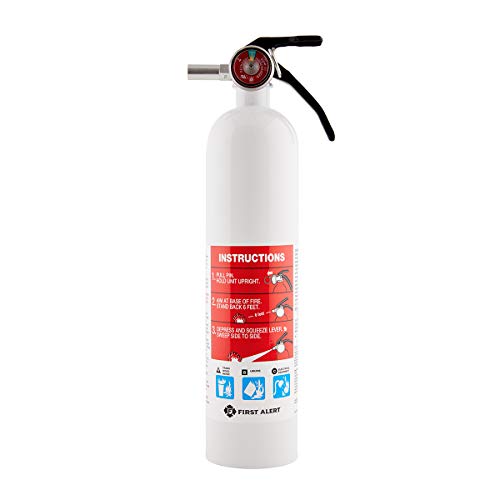
- Best for: Cabin boats that need one extinguisher covering solids, fuel and electrical fires.
- Fire class figure: 1-A:10-B:C
- Agent: monoammonium phosphate dry chemical
- Design: rechargeable by a certified professional
- Valve: all-metal valve and trigger

- Best for: Owners who want full A:B:C coverage with gauge checks instead of service visits.
- Fire class figure: 1-A:10-B:C
- Agent: 2.5 lb dry chemical
- Design: single-use
- Item weight: 3.9 lb
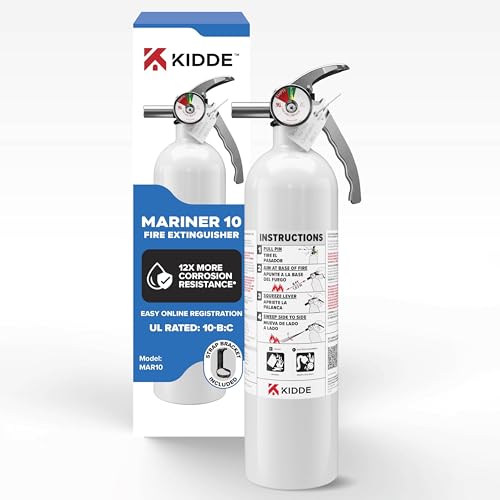
- Best for: Boats whose main risks are fuel, oil and electrical fires around the engine.
- Fire class figure: 10-B:C
- Agent: sodium bicarbonate, 2.5 lb
- Design: single-use
- Item weight: 3.9 lb
All 5 Picks at a Glance
| Product | Specs | Action |
|---|---|---|
| First Alert Marine1 Fire Extinguisher |
| Check price on Amazon |
| Kidde Mariner 110 Fire Extinguisher |
| Check price on Amazon |
| Kidde Mariner 10 Fire Extinguisher |
| Check price on Amazon |
 Kidde Mariner 5 Fire Extinguisher |
| Check price on Amazon |
 Kidde Mariner PWC Fire Extinguisher |
| Check price on Amazon |
Key takeaways
- Five Coast Guard approved marine fire extinguishers compared by fire class figure, agent and bracket, from a rechargeable ABC unit to a slim PWC model.
Buying a boat extinguisher is really two decisions made at once: whether the unit’s fire class figure matches the fires your boat can actually produce, and whether its Coast Guard approval still counts once it is mounted the way you plan to mount it. Get either half wrong and the can on board is decoration. Fuel, oil, batteries and galley gear create different fires, and the label, not the paint color, says which ones a given extinguisher is built to stop.
This roundup is for owners of small open boats, cabin cruisers and personal watercraft who need an approved extinguisher that fits a real compartment. Every pick was chosen from its Amazon listing name and specifications: the printed fire class figure, the agent inside, the bracket in the box and whether the design is single-use or rechargeable. Those four facts separate the five units below more honestly than brand badges do.
Quick Picks
As an Amazon Associate we earn from qualifying purchases
| Product | Best for | Key spec from title |
|---|---|---|
| First Alert Marine1 Fire Extinguisher | Cabin boats needing Class A coverage | 1-A:10-B:C figure, rechargeable |
| Kidde Mariner 110 Fire Extinguisher | Broad coverage without servicing | 1-A:10-B:C figure, single-use |
| Kidde Mariner 10 Fire Extinguisher | Fuel and electrical fires first | 10-B:C figure, 2.5 lb agent |
| Kidde Mariner 5 Fire Extinguisher | Small open boats and skiffs | 5-B:C figure, 11.3 in tall |
| Kidde Mariner PWC Fire Extinguisher | Jet skis and personal watercraft | 5-B:C figure, 2.9 in diameter |
How to Choose
Match the Fire Class Figure to Your Boat’s Risks
The figure printed on the label tells you which fires the extinguisher is built for, and boats carry three kinds. Class A covers ordinary solids such as wood, paper, cushions and trash. Class B covers flammable liquids and gases, which on a boat means fuel and oil. Class C covers energized electrical equipment. A 1-A:10-B:C unit handles all three; a 5-B:C or 10-B:C unit skips solids entirely. Read the figure on the listing before anything else, because a B:C-only can is the wrong tool for a cabin fire involving bedding or timber.
Check the Coast Guard Approval and Bracket
Coast Guard approval for the units in this article is tied to mounting. Each listing states approval applies when the extinguisher sits in the bracket supplied with it, so a loose can rolling around a locker may not count as the approved installation an inspector expects. Check what the listing bundles: most here include a plastic strap bracket, while the First Alert pairs its extinguisher with a metal bracket. Plan the mounting spot before ordering, near the helm or cabin exit, reachable without climbing over the very engine or galley that might be burning.
Single-Use Versus Rechargeable
Four of the five units here are single-use: once discharged, even partly, they are replaced rather than refilled, and their listings lean on long service lives and a gauge check as the whole maintenance routine. The First Alert Marine1 is the rechargeable exception, which suits owners who prefer a service visit over a replacement purchase and want a metal valve assembly. Neither route is wrong, but mixing them up is: a discharged single-use can that goes back on its bracket looks ready and is not, so mark any used unit clearly.
Size, Weight and Where It Mounts
Extinguishers only help if they fit the boat and stay where you put them. The cans here run from 11.3 to 14 inches tall and roughly 3 to 4 lb, yet those small gaps decide whether a unit slides into a jet ski box, a helm locker or a seat base. Measure the compartment and the mounting surface, including bracket depth, before choosing. Weight matters underway as well: a heavier rechargeable unit needs its bracket fastened into something solid, not thin liner panels that can tear free in chop.
The 5 Best Options
First Alert Marine1 Fire Extinguisher
- Best for: Cabin boats that need one extinguisher covering solids, fuel and electrical fires.
- Fire class figure: 1-A:10-B:C
- Agent: monoammonium phosphate dry chemical
- Design: rechargeable by a certified professional
- Valve: all-metal valve and trigger
Cabin boats that need one extinguisher covering solids, fuel and electrical fires.
Recharging must be done by a certified professional, and approval depends on using the included bracket.
The Marine1 is the pick for owners who want one extinguisher that covers the widest spread of boat fires. Its listing pairs a 1-A:10-B:C figure with a monoammonium phosphate charge, so it addresses wood, paper and trash in the cabin as well as fuel, oil and electrical fires. The valve and trigger are metal rather than plastic, and the unit can be recharged by a certified professional after use instead of being thrown away. Coast Guard approval applies when it sits in its supplied bracket, which the listing bundles with the extinguisher.
Kidde Mariner 110 Fire Extinguisher
- Best for: Owners who want full A:B:C coverage with gauge checks instead of service visits.
- Fire class figure: 1-A:10-B:C
- Agent: 2.5 lb dry chemical
- Design: single-use
- Item weight: 3.9 lb
Owners who want full A:B:C coverage with gauge checks instead of service visits.
It is single-use, so any discharge means buying a replacement.
Choose the Mariner 110 when you want Class A coverage in a single-use can that asks almost nothing of you between seasons. The listing gives it the same 1-A:10-B:C figure as larger rechargeable units, with a 2.5 lb dry chemical charge in a 3.9 lb can. There is no recharge appointment to book: you check the gauge, keep it on its strap bracket, and replace it after any discharge. Its 14-inch height suits helm lockers and under-seat storage on mid-size boats.
Kidde Mariner 10 Fire Extinguisher
- Best for: Boats whose main risks are fuel, oil and electrical fires around the engine.
- Fire class figure: 10-B:C
- Agent: sodium bicarbonate, 2.5 lb
- Design: single-use
- Item weight: 3.9 lb
Boats whose main risks are fuel, oil and electrical fires around the engine.
There is no Class A coverage, so it is the wrong sole extinguisher for a furnished cabin.
The Mariner 10 drops Class A coverage and puts its whole charge behind the fires boaters fear most: fuel and electrical. Its 10-B:C figure is double the B figure of the smaller Mariner 5, delivered by 2.5 lb of sodium bicarbonate from a can the same size as the Mariner 110. The listing states a 6-to-8-foot discharge range and an 8-to-12-second discharge, so it is built for standing back from an engine compartment flare-up rather than leaning into it.
Kidde Mariner 5 Fire Extinguisher
- Best for: Small open boats, skiffs and dinghies with tight storage.
- Fire class figure: 5-B:C
- Agent: sodium bicarbonate, 2 lb
- Design: single-use
- Item weight: 3.2 lb
Small open boats, skiffs and dinghies with tight storage.
The 4-to-6-foot discharge range is the shortest here, so you must get close to the fire.
The Mariner 5 is the compact compliance answer for small open boats where every locker is already spoken for. It carries a 5-B:C figure with 2 lb of sodium bicarbonate in the shortest can in this group, standing 11.3 inches tall and weighing 3.2 lb. The trade is reach and capacity: the listing puts its discharge range at 4 to 6 feet, the shortest here. For a skiff, dinghy or small center console, that trade is usually worth making.
Kidde Mariner PWC Fire Extinguisher
- Best for: Jet ski and personal watercraft storage boxes.
- Fire class figure: 5-B:C
- Model: KD57W-5BC
- Agent: sodium bicarbonate, 2 lb
- Item weight: 3.2 lb
Jet ski and personal watercraft storage boxes.
The slim can still needs its strap bracket fitted, or approval and security are both lost.
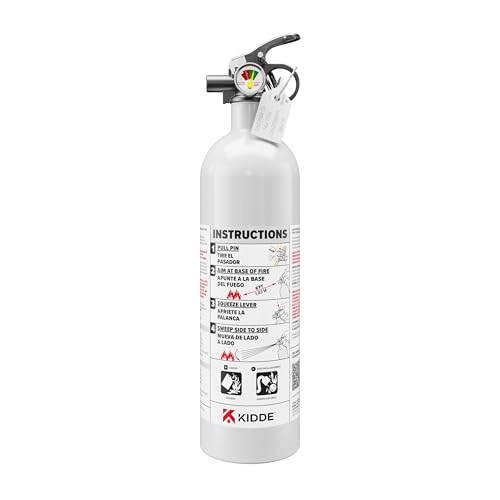
Jet ski storage boxes reject most extinguishers on size alone, and the Mariner PWC is shaped around that problem. Its can is slimmer than the other Kidde units here, at 2.9 inches across, and the listing builds it for personal watercraft compartments. The 5-B:C figure and 2 lb sodium bicarbonate charge match the Mariner 5, aimed at the fuel and electrical fires a PWC can produce. Coast Guard approval again runs through the supplied strap bracket, so mount it rather than letting it rattle loose.
Which One Fits Your Situation
A Small Open Boat That Needs Basic Compliance
A center console or skiff with no cabin has fuel and electrical risk but few solids worth a Class A figure. The Kidde Mariner 5 covers that profile in the shortest can here, and its strap bracket keeps it legal and reachable. If the boat carries a larger fuel load or an enclosed engine box, step up to the Mariner 10 for double the B figure.
A Cabin Cruiser With a Galley and Berths
Berths, a galley and soft furnishings put Class A material all through a cruiser, so the figure needs an A in it. The First Alert Marine1 brings 1-A:10-B:C coverage with a rechargeable metal-valve build, while the Kidde Mariner 110 matches the figure in single-use form. Larger cruisers should carry a second unit aft rather than rely on one can for the whole boat.
A Jet Ski or Small Personal Watercraft
A personal watercraft gives you one small storage box and no mounting wall worth the name. The Kidde Mariner PWC is the only unit here shaped for that space, with a slimmer 2.9-inch diameter and a 5-B:C figure aimed at fuel and electrical fires. Use its strap bracket inside the compartment so the can stays put when the bow slams.
A Spare Unit for a Second Boat or Dock Box
Owners running two boats, or keeping a dock box for guests and rentals, need units that forgive neglect between checks. The single-use Mariner 110 and Mariner 10 ask for a gauge glance rather than a service schedule, and their identical can size means one bracket style covers both. Date each can when it goes aboard so replacements never depend on memory.
Common Mistakes
- Buying a B:C-only extinguisher for a boat with berths, cushions and a galley that can feed a Class A fire.
- Leaving the extinguisher loose in a locker instead of mounting it in the supplied bracket its approval depends on.
- Putting a partly discharged single-use unit back on its bracket and treating it as ready for the next trip.
- Ignoring the pressure gauge for a whole season while salt air corrodes the can and valve.
- Mounting the only extinguisher inside the engine compartment, where the fire it is meant for can block access.
Frequently Asked Questions
How many fire extinguishers does a boat need?
The count depends on the vessel’s length, construction and whether it has a fixed extinguishing system in the engine space, all set by current Coast Guard carriage rules. Small open boats often need one approved unit; larger boats need more, or larger ones. Check the rules for your exact boat before launch day, because the requirement is specific and inspectors do check dates and gauges.
Does the mounting bracket really affect approval?
For the extinguishers in this article, yes. Their listings state Coast Guard approval applies when the unit is mounted in the bracket supplied with it. A can stored loose in a locker can shift, suffer damage and take longer to reach, and it may not satisfy an inspection. Fit the bracket in a visible, reachable spot and keep the gauge facing outward.
Can I recharge a marine fire extinguisher after using it?
Only the rechargeable designs, and only through a certified service professional with the right agent and parts. The First Alert Marine1 here is built for that route. The four Kidde Mariner units are single-use: after any discharge they are replaced, not refilled at home. Never return a partly discharged extinguisher to its bracket and treat it as ready.
How often should I check the extinguisher on my boat?
Glance at the pressure gauge every trip and give the unit a closer look monthly: needle in the green, pin and seal intact, no corrosion on the can or valve, and the bracket still holding firm. Salt air works on metal quietly, which is why these listings favor aluminum cans and corrosion-resistant finishes. Replace or service any unit that fails a check.