Our Short List of 3

All 4 Picks at a Glance
| Product | Specs | Action |
|---|---|---|
| 1. BN-LINK Digital Heat Mat Thermostat — Best Simple Pick for One Heat Mat | Check price on Amazon | |
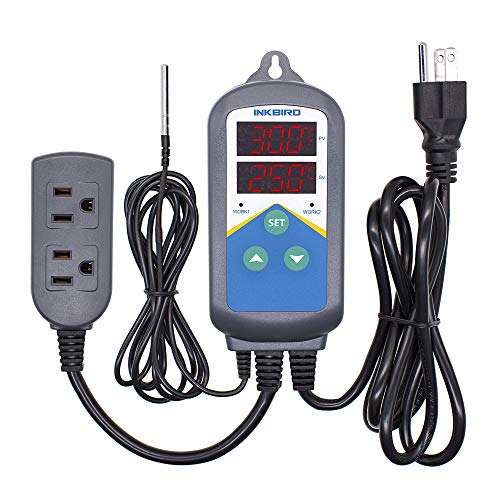 2. Inkbird ITC-306T — Best for a Day and Night Drop | Check price on Amazon | |
 3. Inkbird ITC-308 — Best Dual-Stage Pick for Heating and Cooling | Check price on Amazon | |
 4. Zoo Med ReptiTemp RT-600 — Best Reptile-Brand Pick with Alarm | Check price on Amazon |
Key takeaways
- Compare the best thermostats for snakes for heat mats, ceramic emitters and radiant panels, with on/off and dual-stage picks, probe placement and safety guidance.
As an Amazon Associate we earn from qualifying purchases.
Affiliate Disclosure: This article contains affiliate links. If you buy through a link on this page, we may earn a commission at no extra cost to you.
A heat source without a thermostat is not a heating system. It is an unregulated heater that keeps climbing until the enclosure, the substrate, or the animal pays for it. Under-tank heat mats, heat tape, ceramic heat emitters, and radiant heat panels can all overshoot the warm side a snake actually needs, and a snake cannot leave a closed vivarium to escape that mistake. A thermostat is the device that sits between the wall outlet and the heater, reads a probe inside the enclosure, and switches or modulates power so the warm spot stays where you set it. For snakes, that single piece of equipment does more for safety than any upgraded enclosure or decorative hide.
This guide covers reptile thermostats only — the plug-in controllers made for vivariums and terrariums — not household heating thermostats, which cannot read a probe on a heat mat and were never designed for this job. The four picks below cover the main ways snake keepers actually heat enclosures: a simple on/off controller for a single heat mat, a day and night controller for keepers who want a night drop, a dual-stage unit that can run heating and cooling, and a reptile-brand controller with heat and cool modes and a built-in alarm. Every specification cited comes from the product listing or manufacturer documentation for that model, and we do not claim to have practical tested any of them.
Quick Picks
- BN-LINK Digital Heat Mat Thermostat (B01I15S6OM) — Best simple pick for a single heat mat or heat tape run.
- Inkbird ITC-306T (B015FKG4CC) — Best for a day and night temperature drop on a timer cycle.
- Inkbird ITC-308 (B01HXM5UAC) — Best dual-stage option when a cooling fan needs to run from the same controller.
- Zoo Med ReptiTemp RT-600 (B07FYXX9L3) — Best reptile-brand pick with heat and cool modes and a high/low alarm.
Why Every Snake Heat Source Needs a Thermostat
Snakes are ectotherms. They regulate body temperature by moving between a warm zone and a cool zone, which means your enclosure has to offer both, and the warm zone has to stay inside a safe band. For a ball python, keepers commonly target a warm-side surface around the high eighties to low nineties Fahrenheit, with a cooler side in the mid to high seventies. For a corn snake, the warm side is usually kept a little lower. The exact numbers vary by species, but the principle never changes: the warm spot must be controlled, not guessed.
An uncontrolled heat mat can climb far past those targets, especially under a glass tank where heat builds against the floor. Burns from unregulated heaters are one of the most preventable injuries in snake keeping, and they happen slowly, because a snake will often stay on an overly hot surface rather than move. A thermostat prevents that in two ways. It caps the temperature at your set point, and its probe gives you a continuous reading at the place that matters — the surface the snake rests on — instead of a guess based on room temperature.
A thermostat is not the same as a thermometer. A thermometer only tells you the temperature. A thermostat acts on it. You still need an independent thermometer, ideally a digital probe thermometer or an infrared temperature gun, to verify that the thermostat probe is reading honestly. The thermostat controls, the thermometer confirms, and that pairing is the basic safety setup for any heated snake enclosure.
The Three Control Types, in Plain Terms
On/off thermostats are the most common and the simplest. When the probe reads below your set point, the heater runs at full power. When it reaches the set point, power cuts completely. Temperatures drift a little above and below the target as the unit cycles, which is acceptable for heat mats, heat tape, and ceramic emitters. It is a poor match for light-emitting basking bulbs, because the constant switching shortens bulb life and produces visible flicker.
Pulse proportional thermostats send rapid pulses of power that get longer or shorter as the temperature approaches the set point. The result is a steadier temperature with less overshoot, and these units suit heat mats, tape, and ceramic emitters well.
Dimming thermostats reduce power smoothly rather than switching it, which makes them the correct choice for light-emitting heat bulbs, because the bulb dims instead of blinking. If your snake setup uses a basking lamp as its main heat source, a dimming model — not any of the on/off units in this list — is the type to buy, and you should confirm the specific model is rated for dimming before ordering.
All four picks in this guide are on/off controllers. That is deliberate: most pet snakes in glass tanks or tubs are heated with mats, tape, ceramic emitters, or radiant panels, and on/off control handles all of those safely. Lamp keepers should treat this list as a starting point for mat and emitter control and shop the dimming category separately for the lamp itself.
1. BN-LINK Digital Heat Mat Thermostat — Best Simple Pick for One Heat Mat
The BN-LINK is the controller many keepers start with, and for a single snake on a single heat mat, it covers the job without extra features getting in the way. The listing describes a control range of 40 to 108 degrees Fahrenheit, a maximum load of 1000W, and ETL listing. Setup uses three buttons: set the target temperature, place the probe, and plug the heater into the controlled outlet.
For snake use, place the probe where the snake actually contacts the heat — sandwiched between the mat and the enclosure floor for an under-tank mat, or fixed at floor level inside, directly over the heated area. Set the target to your species’ warm-side surface temperature, then verify with an independent thermometer after the enclosure has had time to stabilise. The 1000W ceiling is far above what a single mat or a modest ceramic emitter draws, so the limit is rarely the issue; probe placement is what decides whether the reading is true.
The honest limits are the ones shared by every on/off unit. The temperature will swing a few degrees around the set point as it cycles, it offers no day and night programming, and it should not be used to control a light-emitting basking bulb. For a quarantine tub, a first ball python tank, or a rack running heat tape, none of that is a deal-breaker. It is a heating-only controller, so it will not run a cooling fan in a hot room — if your reptile room regularly pushes the cool side too high in summer, look at the dual-stage picks below instead.
2. Inkbird ITC-306T — Best for a Day and Night Drop
The ITC-306T adds the one feature the BN-LINK lacks: a 24-hour day and night cycle. The listing describes a heating-only controller with a maximum output of 1200W, two heating outlets fed from one relay, a temperature control range of minus 58 to 210 degrees Fahrenheit, a sensor lead of about 6.56 feet, temperature calibration, and over-temperature and sensor fault alarms.
The day/night function lets you program two different set points across a 24-hour cycle, so the warm side can ease down overnight and come back up in the morning, closer to the rhythm many snakes experience in the wild. Both outlets follow the same program — this is one control zone with two sockets, not two independent zones — so it suits one enclosure with two heat sources that should rise and fall together, such as a mat plus a low-wattage ceramic emitter.
Calibration matters more than it sounds. If the probe reads a couple of degrees off against your reference thermometer, you can offset the controller instead of doing mental arithmetic every time you check. The alarms also earn their place: a sensor fault alarm warns you if the probe fails or disconnects, which is exactly the failure that turns a controlled heater into an uncontrolled one. Note the listing summary captured during research showed no featured offer on one crawl for this model, so check the current listing carefully before relying on it — the specifications above are from the manufacturer’s listing documentation for the ITC-306T.
3. Inkbird ITC-308 — Best Dual-Stage Pick for Heating and Cooling
The ITC-308 is a dual-relay controller: one outlet stage for heating and one for cooling. The listing describes a maximum load around 1100 to 1200W depending on the version, dual displays showing measured and set temperatures together, temperature calibration, and high and low alarm settings.
Most snake keepers only need the heating stage, and on that side the ITC-308 behaves like a capable on/off controller for a mat, tape, or ceramic emitter. The cooling stage becomes useful in a warm room or a garage setup where summer ambient temperatures push the enclosure’s cool side above target — a small fan plugged into the cooling outlet can pull air through the enclosure when the probe reads too high. That two-sided control is the reason to choose this model over a heating-only unit.
Because it is a general-purpose controller also sold for brewing and aquariums, take an extra minute at setup: confirm you are programming the heating stage, set the compressor delay and alarm limits sensibly for a reptile rather than a fridge, and double-check the probe is secured where the snake cannot dislodge it and park its body on top of it, which would give a false reading. Used carefully, it is the most flexible controller in this list, and the one to pick if your room temperature swings are as much of a problem as the heater itself.
4. Zoo Med ReptiTemp RT-600 — Best Reptile-Brand Pick with Alarm
The ReptiTemp RT-600 is the one pick here designed and sold specifically as a reptile thermostat by a reptile brand. Zoo Med’s product information describes a control range of 50 to 122 degrees Fahrenheit, capacity for up to 600W of heating devices in HEAT mode or up to 150W of cooling devices in COOL mode, a remote temperature sensor on a 6-foot cable, built-in memory that stores settings through a power failure, and an alarm that flashes and sounds when temperature reaches extreme high or low levels.
That feature set maps neatly onto a single snake enclosure. The 600W heating ceiling is comfortably above any single mat or emitter a typical pet snake setup uses. The memory function means a brief outage does not reset your set point to a default you did not choose. The audible alarm is a genuine safety plus in a home setup, because it can alert you to a failed heater or a stuck relay even when you are not standing in front of the tank — though you have to be within earshot, so it complements rather than replaces regular thermometer checks.
The limits are straightforward: one controlled device at a time rather than a bank of outlets, on/off control rather than dimming, so again no light-emitting basking bulbs, and a control range that starts at 50 degrees, which is fine for snakes but worth noting if you ever repurpose a controller for cooler applications. One crawl of the Amazon search results during research showed this model with no featured offer and third-party offers instead, so verify the seller and the exact RT-600 model on the listing before ordering.
How to Set Up a Snake Thermostat Safely
First, decide what the thermostat is controlling and say it plainly: one heat source per control zone. A mat under one end of the enclosure is the classic arrangement, creating a warm end and a cool end. Second, fix the probe so it cannot move. For an under-tank mat, the probe belongs between the mat and the glass, or inside at floor level directly above the mat, secured so the snake cannot push it into a cool corner — a wandering probe is the most common cause of overheating, because the controller keeps heating while it waits for a reading that never comes.
Third, set the target at the surface, not in the air. Snake warm-side targets are surface temperatures where the belly rests. Fourth, verify independently for at least a full day cycle with a separate thermometer or temperature gun, checking the warm surface, the cool side, and the ambient air. Fifth, recheck after any change: new substrate depth, a moved water bowl, a different room, or a seasonal change in house temperature all shift how an enclosure holds heat.
Never run a heat source in a snake enclosure without a thermostat because it worked fine last week, and never plug two different enclosures with different needs into one probe and hope they match. If you keep several snakes, the safe pattern is one controlled zone per enclosure, even when that means several modest controllers instead of one large one.
How to Choose Among These Four
Choose the BN-LINK if you have one snake, one heat mat or tape run, and no need for a night drop or cooling. Choose the ITC-306T if you want an automatic day and night temperature change and appreciate calibration and sensor alarms. Choose the ITC-308 if your room itself gets too warm and a cooling fan needs thermostatic control alongside the heater. Choose the ReptiTemp RT-600 if you prefer reptile-specific equipment, value power-failure memory, and want an audible high/low alarm on a single enclosure.
Whichever you pick, match the control type to the heat source before anything else: on/off for mats, tape, ceramic emitters, and radiant panels; dimming for light-emitting bulbs; and a wattage ceiling comfortably above the combined load you will actually plug in. Then check the listing for the exact model and ASIN before ordering, because several of these brands sell look-alike controllers for seed germination and brewing with different plugs, ranges, and relay arrangements.
Frequently Asked Questions
Can I use a household thermostat for my snake? No. A home heating thermostat reads room air at the wall and switches a furnace or air conditioner. It cannot read a probe on a heat mat or control a plug-in heater safely. Use a reptile or plug-in probe thermostat like the ones above.
Where should the probe go for a heat mat? At the heated surface the snake touches — between the mat and the enclosure floor, or secured inside at floor level over the mat — fixed so the snake cannot move it.
Do I still need a thermometer if I have a thermostat? Yes. The thermostat controls temperature; an independent thermometer verifies the probe is telling the truth. Check both regularly.
Is on/off control safe for ceramic heat emitters? Yes. Ceramic emitters produce no light, and on/off cycling is a normal way to control them. Save dimming thermostats for light-emitting bulbs.
What temperature should I set? Set the warm-side surface for your species — commonly the high eighties to low nineties Fahrenheit for a ball python, somewhat lower for a corn snake — and confirm against a current care reference for the exact animal you keep, keeping a clearly cooler zone available at all times.